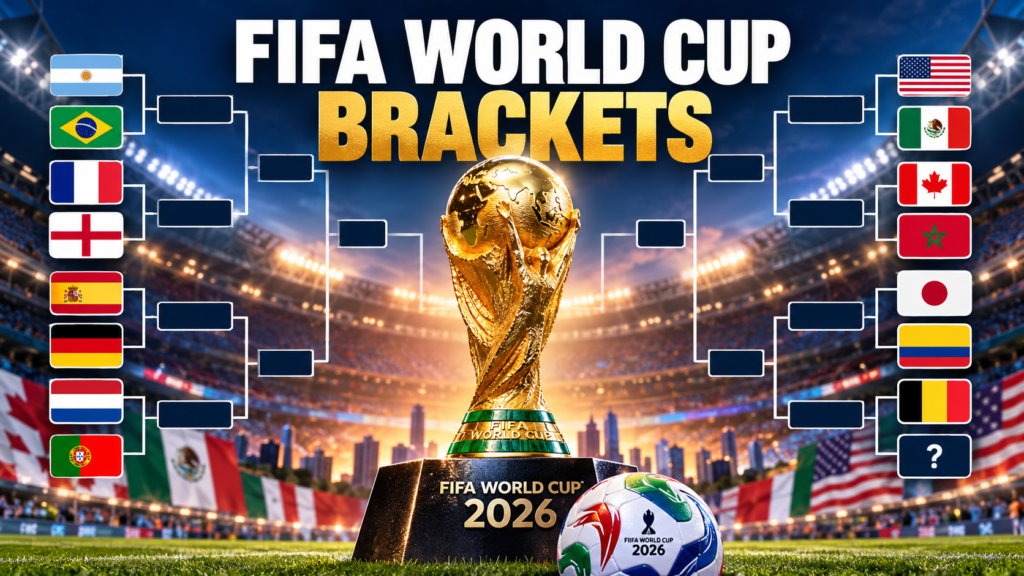
FIFA World Cup Brackets help football fans follow every team’s journey from the group stage to the World Cup final. They show which teams face each other, who advances after each match, and how every possible route leads toward the championship.
The FIFA World Cup 2026 brought a major change to the traditional bracket system. For the first time, 48 national teams competed instead of 32. The larger tournament introduced a new Round of 32, creating more knockout matches and a longer road to the trophy.
The 2026 World Cup took place across Canada, Mexico, and the United States from June 11 to July 19. A total of 104 matches were played, compared with 64 matches during the previous 32-team format.
Spain completed its journey through the 2026 bracket by defeating Argentina 1-0 after extra time in the final. It was Spain’s second men’s FIFA World Cup title.
Understanding how the bracket works makes it much easier to follow the tournament. From the Round of 32 to the final, every match has a direct effect on what happens next.
What Are FIFA World Cup Brackets?
A FIFA World Cup bracket is a visual chart that shows the knockout path of teams after the group stage.
During the group stage, teams earn points across several matches. A win gives a team three points, while a draw gives one point. Teams are then ranked within their groups.
The knockout stage works differently.
Once a team enters the bracket, it must continue winning to stay in the tournament. Lose one knockout match, and the World Cup journey is normally over.
A World Cup bracket usually shows two teams connected to one match. The winner moves forward and enters another match against the winner from a different section of the bracket.
This continues until two teams remain.
Those two nations meet in the FIFA World Cup final.
Also Read https://cherrymagazine.co.uk/tom-cruise-net-worth/
How FIFA World Cup Brackets Changed in 2026
The 2026 World Cup created the largest bracket in the history of the men’s competition.
Previous editions from 1998 through 2022 featured 32 teams divided into eight groups. Sixteen teams advanced to the knockout stage, meaning the bracket started with the Round of 16.
That changed in 2026.
FIFA expanded the tournament to 48 teams and divided them into 12 groups of four. Every team played three matches during the group stage.
After the group stage, 32 teams advanced.
They included:
- 12 group winners
- 12 group runners-up
- 8 best third-place teams
These 32 teams entered the new Round of 32.
The winners then progressed through the Round of 16, quarter-finals, semi-finals, and final.
Because of the extra knockout round, teams reaching the final could play eight matches instead of the seven required under the old 32-team system.
FIFA World Cup 2026 Bracket Format
The expanded structure created a longer knockout journey.
| Tournament Stage | Teams Remaining | Number of Matches |
|---|---|---|
| Group Stage | 48 | 72 |
| Round of 32 | 32 | 16 |
| Round of 16 | 16 | 8 |
| Quarter-finals | 8 | 4 |
| Semi-finals | 4 | 2 |
| Third-place Match | 2 | 1 |
| Final | 2 | 1 |
There were 72 group-stage games and 32 matches after the group stage, bringing the tournament total to 104 matches.
The new structure gave more countries an opportunity to compete at the World Cup while also increasing the importance of understanding the knockout bracket.
How Teams Qualified for the Knockout Bracket
The first and second-placed teams in each of the 12 groups automatically reached the Round of 32.
That created 24 qualified teams.
The remaining eight positions went to the best third-place teams across all 12 groups.
This meant finishing third did not automatically end a country’s tournament.
Teams finishing third had to compare their results with other third-place nations. Factors such as points, goal difference, and other tournament tiebreakers could determine which teams advanced.
Once all 32 qualifying teams were known, the knockout bracket could move forward.
From that stage, every match became an elimination game.
How Knockout Matches Work
World Cup knockout matches cannot finish as draws.
Teams first play the normal 90 minutes, divided into two 45-minute halves.
If the scores are level after 90 minutes, the match goes into extra time.
Extra time consists of two additional 15-minute periods.
If the score is still tied after 120 minutes, the winner is decided through a penalty shootout.
During the 2026 World Cup, several matches required either extra time or penalties, adding even more drama to the bracket.
Penalty shootouts are especially exciting because the entire tournament can come down to only a few kicks.
FIFA World Cup Brackets Round of 32
The Round of 32 was one of the biggest changes introduced at the 2026 FIFA World Cup.
Thirty-two teams entered this round, creating 16 knockout matches.
The stage included major football nations alongside teams making deep World Cup runs that might have been harder under previous qualification formats.
Some important Round of 32 results included France defeating Sweden 3-0, Mexico beating Ecuador 2-0, England defeating Congo DR 2-1, and Spain beating Austria 3-0.
Argentina needed extra time to defeat Cabo Verde 3-2, while Egypt progressed after beating Australia in a penalty shootout.
Sixteen winners remained after the round.
Those teams moved into the traditional Round of 16.
FIFA World Cup Brackets Round of 16
The Round of 16 narrowed the tournament from 16 teams to eight.
At this stage, there was little room for mistakes.
France started the round by defeating Paraguay 1-0, while Morocco produced an impressive 3-0 victory over co-host Canada.
Norway recorded one of the notable results of the round by beating Brazil 2-1.
England survived a difficult match against Mexico and advanced with a 3-2 victory.
Spain defeated Portugal 1-0, while Belgium ended the United States’ tournament with a 4-1 win.
Argentina beat Egypt 3-2, and Switzerland advanced against Colombia following a penalty shootout after the match finished 0-0.
The results created eight quarter-finalists:
France, Morocco, Norway, England, Spain, Belgium, Argentina, and Switzerland.
Visit https://cherrymagazine.co.uk/anthony-joshua-net-worth/.
World Cup Quarter-Final Bracket
The quarter-finals are often considered one of the most exciting stages of any World Cup.
Only eight teams remain, and every country is just three victories away from becoming world champion.
France faced Morocco in the first 2026 quarter-final and earned a 2-0 victory.
Spain then defeated Belgium 2-1.
England’s meeting with Norway required extra time before England earned a 2-1 victory.
Argentina also needed extra time against Switzerland but eventually won 3-1.
Those results created two major semi-final matches:
France vs Spain
and
England vs Argentina
At this point, the huge 32-team knockout bracket had been reduced to just four countries.
FIFA World Cup Semi-Final Bracket
The semi-finals determine which teams will compete for the World Cup trophy.
They also carry enormous pressure because teams are only one victory away from reaching the final.
Spain faced France in Dallas on July 14, 2026.
Spain won the match 2-0 and secured its place in the final.
The second semi-final featured England and defending champion Argentina in Atlanta.
Argentina won 2-1 and joined Spain in the championship match.
The semi-final results created the final pairing:
Spain vs Argentina
Meanwhile, France and England moved into the third-place match.
Third-Place Match
Teams that lose in the semi-finals do not immediately leave the competition.
Instead, they play in the third-place match, sometimes called the bronze final.
In 2026, England and France met in Miami on July 18.
England defeated France 6-4 in a high-scoring match to finish third in the tournament.
Although the third-place match does not decide the champion, it remains part of the official World Cup bracket and gives both semi-final losers one final opportunity to finish the competition with a victory.
FIFA World Cup 2026 Final
Every section of the bracket eventually leads to one match: the FIFA World Cup final.
Spain and Argentina met at New York New Jersey Stadium on July 19, 2026.
The match remained scoreless during normal time and moved into extra time.
Ferran Torres finally broke the deadlock in the 106th minute, scoring the goal that gave Spain a 1-0 victory.
Spain became world champion for the second time, adding the 2026 trophy to the country’s previous World Cup victory in 2010.
Argentina finished as runners-up after entering the tournament as defending champions.
The final completed a knockout bracket that began with 32 teams and ended with Spain standing alone as champion.
Spain’s Route Through the 2026 World Cup Bracket
Following a team’s individual path is one of the easiest ways to understand how World Cup brackets work.
Spain’s knockout journey looked like this:
| Stage | Opponent | Result |
|---|---|---|
| Round of 32 | Austria | Spain 3-0 Austria |
| Round of 16 | Portugal | Spain 1-0 Portugal |
| Quarter-final | Belgium | Spain 2-1 Belgium |
| Semi-final | France | Spain 2-0 France |
| Final | Argentina | Spain 1-0 Argentina AET |
Spain had to win five consecutive knockout matches after progressing from the group stage.
The route shows why brackets are useful. Fans can immediately see which opponents a team defeated and how its path developed from one round to another.
Why World Cup Brackets Are Popular With Fans
Brackets make a complicated tournament much easier to understand.
Instead of checking dozens of separate fixtures, fans can look at one bracket and see the entire knockout structure.
They can identify possible future matches and see which teams could meet later in the tournament.
For example, once the quarter-final positions are known, supporters can see which quarter-final winners are scheduled to face each other in the semi-finals.
This makes brackets useful for casual viewers as well as dedicated football fans.
They are also popular in offices, schools, sports websites, social media communities, and groups of friends.
Many fans fill out their brackets before knockout matches begin and predict which countries will advance.
How to Read a FIFA World Cup Bracket
Reading a bracket becomes simple once you understand its basic design.
Start from the first knockout round.
Two teams will usually appear beside each other with a line connecting them to the next stage.
The winning team moves along that line.
For example:
Spain vs Austria → Spain
Spain then moved forward to face Portugal.
Portugal vs Spain → Spain
Spain advanced again and faced Belgium.
The process continued until Spain reached the final.
Following the connecting lines allows fans to track any team’s entire path through the tournament.
Why One Side of the Bracket Matters
Tournament brackets are divided into different paths.
Teams on one part of the bracket cannot meet teams from another section until a later round.
This can create interesting possibilities.
Two major football nations may be placed on the same side and therefore have to meet before the final.
Other teams might stay separated until the semi-final or championship match.
That is why football fans often discuss a team’s “side of the bracket.”
Knowing the bracket does not tell us which team will win, but it tells us which opponents a country may have to face if it keeps advancing.
Printable FIFA World Cup Brackets
Printable World Cup brackets are popular because fans can update them as matches are completed.
A typical printable bracket contains empty spaces for:
- Round of 32 winners
- Round of 16 winners
- Quarter-final winners
- Semi-final winners
- Third-place result
- World Cup champion
Before the knockout stage starts, fans can also fill in their predictions.
After each match, they can compare those predictions with the actual results.
Digital brackets work in a similar way but can update automatically as results become official.
FIFA World Cup Bracket Predictions
Bracket predictions have become an important part of the fan experience.
Supporters often predict every knockout result before matches begin.
Some predictions are based on FIFA rankings or recent results. Others consider squad strength, injuries, playing style, previous World Cup performances, and the difficulty of a team’s path.
However, World Cup football is famous for unexpected results.
A highly ranked country can lose a single match and immediately leave the competition.
That unpredictability is one reason knockout brackets remain so exciting.
Even a carefully predicted bracket can change completely after one surprising result.
How the 2026 Format Made Brackets More Important
The expansion from 32 to 48 teams made the tournament larger and the knockout bracket more detailed.
Under the previous system, fans only needed to track 16 teams after the group stage.
In 2026, 32 teams entered the knockout rounds.
That meant an additional elimination stage, 16 more knockout participants, and more possible routes toward the final.
The new system also meant the eventual finalists had to survive five knockout games rather than four.
With more countries and more elimination matches, fans had even more reasons to use a bracket to follow the competition.
Previous FIFA World Cup Bracket Format
For many years, the FIFA World Cup used a 32-team structure.
That system featured:
- Eight groups of four
- Two qualifying teams from each group
- 16 teams in the first knockout round
- Round of 16
- Quarter-finals
- Semi-finals
- Final
The format was used from the 1998 World Cup through Qatar 2022.
The move to 48 teams represents one of the biggest structural changes in modern World Cup history.
Although the basic idea of knockout football remains the same, the path is now longer.
Frequently Asked Questions About FIFA World Cup Brackets
How many teams are in the World Cup knockout bracket?
The 2026 FIFA World Cup knockout bracket started with 32 teams. The 24 teams finishing first or second in the 12 groups qualified along with the eight best third-place teams.
How many teams played at the 2026 World Cup?
A total of 48 national teams competed in the 2026 FIFA World Cup.
How many matches were played at the 2026 World Cup?
The tournament featured 104 matches, including 72 group-stage matches and 32 matches after the group stage.
What happens if a World Cup knockout match ends in a draw?
If the score is tied after 90 minutes, teams play 30 minutes of extra time. If the match remains tied, a penalty shootout determines the winner.
Is there a Round of 32 in the FIFA World Cup?
Yes. The men’s FIFA World Cup introduced a Round of 32 with the expanded 48-team format in 2026.
Who won the FIFA World Cup 2026?
Spain won the 2026 FIFA World Cup after defeating Argentina 1-0 after extra time in the final on July 19, 2026.
Where was the 2026 World Cup final played?
The final was played at New York New Jersey Stadium in the United States.
How many matches does a team need to play to reach the final?
Under the 2026 format, a finalist plays eight matches: three group-stage matches followed by five knockout games from the Round of 32 through the final.
Conclusion
FIFA World Cup Brackets offer one of the easiest ways to understand the journey from the group stage to the biggest match in international football. They show every knockout pairing, possible route, result, and advancing team in one clear structure.
The introduction of 48 teams changed the World Cup bracket significantly in 2026. A new Round of 32 expanded the knockout stage and gave fans more matches to follow before the Round of 16, quarter-finals, semi-finals, and final.
Spain ultimately completed the entire path, defeating Austria, Portugal, Belgium, France, and Argentina during the knockout rounds to become the 2026 world champion. Whether fans use brackets to follow results, predict winners, or understand possible matchups, FIFA World Cup Brackets remain an essential part of following football’s biggest international tournament.