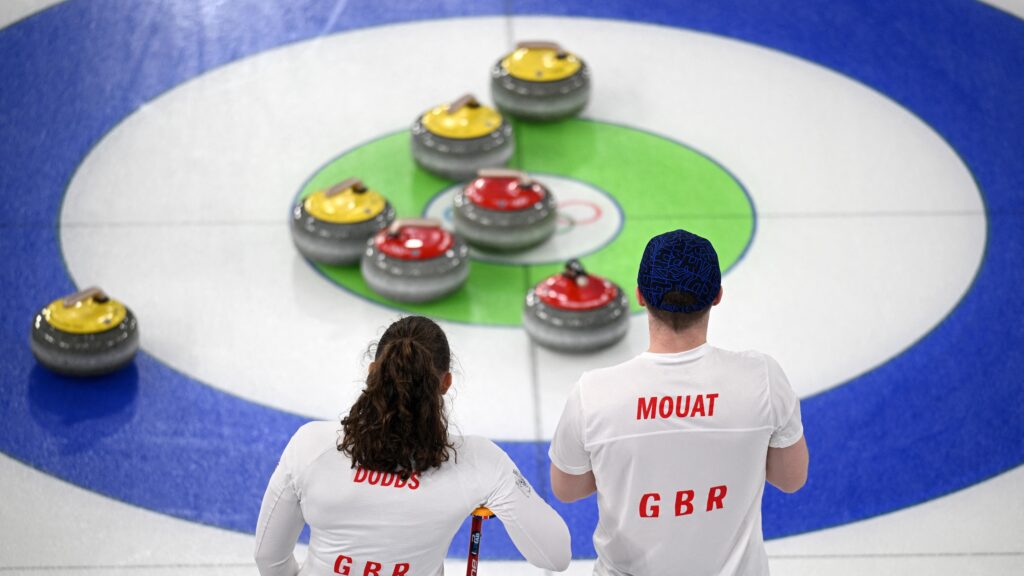
The global winter sports showcase recently turned the international spotlight onto some of the most tactically intense ice disciplines in the world. While the casual viewing public often focuses on the speed of downhill skiing or the high-impact collisions of ice hockey, experienced sports bettors quietly make their profits at the curling rink. Often described as chess on ice, curling is a sport entirely dictated by strategic positioning, friction physics, and team communication. The Winter Olympic curling tournaments, held at the historic Cortina Olympic Stadium, provided a massive volume of highly analytical betting lines.
Understanding the Subtle Physics of Pebble and Ice Friction
The most common mistake an outsider makes when looking at a curling sheet is assuming the ice surface is perfectly flat like a hockey rink. Before a match begins, technicians spray tiny water droplets onto the ice, which freeze instantly to create a textured, bumpy surface known as pebble. As the heavy granite stones slide down the sheet, they ride on top of these microscopic bumps. The friction generated by the stone traveling over the pebble is what causes the rock to curl, or bend, away from a straight path.
Placing your wagers through a data-rich sports platform like 442 Bet gives you an exceptional opportunity to beat the oddsmakers. Let us take an objective look at the core physical variables and tactical rules needed to handicap professional curling successfully.
Tracking the Impact of In-Play Ice Degradation
As an intense multi-end Olympic match progresses, the constant sliding of rocks and aggressive sweeping actions will wear down the pebble structure.
This wear pattern creates a phenomenon known as track breakdown:
- The High-Friction Early Ends: In ends one through three, the fresh pebble offers maximum resistance, causing stones to bend aggressively and allowing for complex guard placements.
- The Flat-Ice Mid-Game Shift: By end five, the common sliding paths become completely flattened, causing the stones to run straighter and faster, heavily favoring aggressive takeaway shots.
- The Frost Build-Up Factor: If the stadium’s internal humidity spikes due to large crowds, microscopic frost will form on the corners of the sheet, completely killing a stone’s momentum.
Comparing Elite National Team Performance Profiles
The global hierarchy of international curling features a mix of traditional alpine nations and specialized tactical programs. Because the margins between a gold-medal shot and a missed stone are measured in millimeters, sportsbooks often struggle to balance the live lines when an elite squad drops an early end.
The table below details the performance parameters and match data recorded during the Olympic medal tournaments this season:
| National Curling Program | Olympic Tournament Classification | Final Medal Result Secured | Core Tactical Team Strength | Primary Strategic Vulnerability |
| Canada | Men’s Winter Tournament | Gold Medal | Elite explosive takeout accuracy | Occasional over-aggression with early guards |
| Great Britain | Men’s Winter Tournament | Silver Medal | Flawless draw weight control | Vulnerable to aggressive counter-sniping |
| Sweden | Women’s Winter Tournament | Gold Medal | Deep tournament veteran composure | Susceptible to rapid ice temperature drops |
| Switzerland | Women’s Winter Tournament | Silver Medal | Exceptional sweeping line coordination | Minor communication errors under heavy time stress |
| Norway | Men’s Winter Tournament | 4th Place Position | High-risk creative angle promotions | Inconsistent rock rotation speed adjustments |
Smart Live Rules for High Value Curling Slips
Securing a long-term profit on the curling board requires you to watch the skip’s body language and look for structural ice anomalies before the software updates the lines.
- Prioritize the hammer advantage above all else: The team that throws the absolute final stone of an end holds the hammer. Having the hammer is a massive mathematical advantage. If a trailing team is down by one point but retains the hammer for the final end, the live odds are frequently mispriced in favor of the leader.
- Monitor the skip’s draw percentage charts: The team captain, or skip, throws the critical final two stones of every end. If a star skip’s draw accuracy falls below 80% during the opening ends, their team will struggle to secure multi-point ends.
- Exploit the directional sweeping metrics: Modern sweeping teams use specialized carbon-fiber brushes to melt the ice pebble momentarily, actively pulling the stone toward a desired path. Pay attention to which teams feature the most physically powerful front-end sweepers.
- Avoid the over-inflated total point lines: Bookmakers often set high total point lines based on easy blowout matches from the round-robin stages. When the high-stakes medal rounds begin, teams play hyper-defensively, leading to low-scoring, cautious ends.
Analyzing the Strategic Blank End
In professional curling, if an end finishes with zero stones remaining inside the scoring house, the score remains unchanged, and the team that held the hammer retains it for the next sequence. This is known as a blank end. Elite teams will intentionally clear the house to blank an end if they cannot secure a major two-point score, using the tactic to preserve their hammer advantage for a more lucrative opportunity later.
Mastering the Data-Driven Flow of Ice Strategy
Wagering on competitive curling turns a quiet winter sport into an incredibly engaging mathematical puzzle. By looking past the slow pace of the broadcast and focusing your research on pebble degradation rates, hammer retention metrics, and individual skip accuracy trends, you can easily identify soft lines before the market corrects itself. Keep your transaction sizes structured, manage your risks through the opening ends carefully, and enjoy the thrill of tracking the world’s most precise tactical winter sport stone by stone.