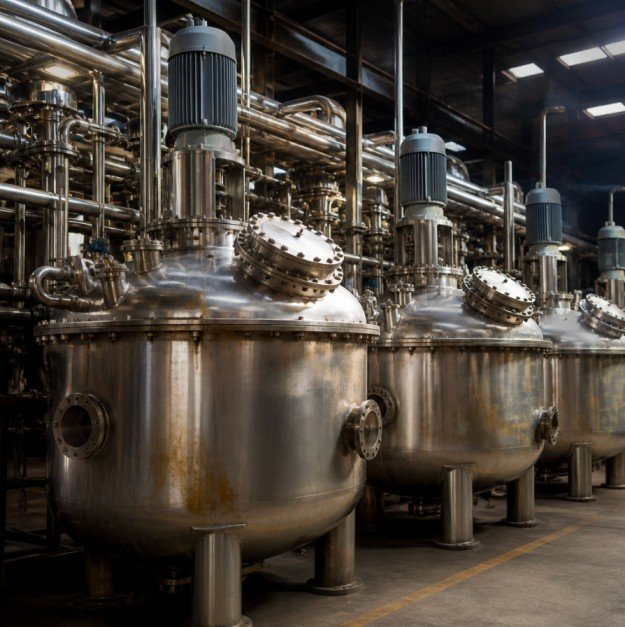
The global chemical processing industry is under constant pressure to balance capital expenditure with operational efficiency. As new plant construction costs continue to climb and lead times for custom-built equipment stretch into years, procurement teams are increasingly turning to the secondary equipment market for solutions. Reactors — the workhorses of chemical, pharmaceutical, and petrochemical manufacturing — are among the most sought-after assets in this space. Understanding how to evaluate, source, and integrate pre-owned reactor systems is no longer a niche skill; it is a core competency for any serious operations or engineering team.
The Economics Behind Secondary Equipment Markets
Capital equipment in the chemical processing sector represents some of the most significant line items in any facility’s budget. A new industrial reactor — depending on its size, material of construction, and pressure rating — can cost anywhere from several hundred thousand to several million dollars. When a facility shuts down, undergoes a product line change, or modernizes its operations, high-quality equipment often becomes available at a fraction of its original cost. This creates a genuine opportunity for buyers who know what to look for and where to find it.
The secondary market is not simply a clearinghouse for worn-out machinery. Many reactors that enter the resale market have been decommissioned due to business decisions rather than mechanical failure. A plant that pivots away from a particular chemical process may retire perfectly functional equipment. For buyers, this means access to well-maintained, often recently inspected vessels that can be redeployed with minimal refurbishment. The key is working with reputable suppliers who provide accurate condition reports, material certifications, and full mechanical histories.
Cost Savings Without Compromising Quality
Purchasing pre-owned process equipment can yield savings of 40 to 70 percent compared to new fabrication, depending on the asset type and market conditions. These savings are not achieved by cutting corners — they reflect the depreciation curve of capital equipment and the efficiency of a well-functioning resale market. For smaller manufacturers, contract processors, and research-scale operations, this cost differential can be the deciding factor between a viable project and one that never leaves the planning stage. Even large multinationals use secondary equipment to accelerate project timelines when new builds would introduce unacceptable delays.
Types of Reactors Commonly Available on the Secondary Market
The range of reactor types available through industrial resellers is broad. Continuous stirred-tank reactors (CSTRs), plug flow reactors, jacketed glass-lined vessels, high-pressure autoclaves, and tubular reactors all appear regularly in secondary inventories. Each type serves distinct process requirements, and buyers must match the reactor’s design specifications to their intended application with precision. Material compatibility is particularly critical — a reactor constructed from 316L stainless steel may be ideal for one process and entirely unsuitable for another involving aggressive acids or chlorinated compounds.
Glass-lined reactors, for instance, are highly valued in pharmaceutical and fine chemical applications where product purity is paramount. These vessels are expensive to manufacture new and require careful inspection when purchased used, as the glass lining can develop microscopic cracks or chips that compromise both product quality and vessel integrity. Reputable suppliers will provide spark testing results and detailed inspection reports to verify lining condition before sale.
Pressure Ratings and Compliance Considerations
One area that demands particular attention when acquiring used reactors is pressure vessel compliance. In most jurisdictions, pressure vessels must meet specific design codes — ASME in North America, PED in Europe, and various national standards elsewhere. A reactor that was originally certified to a particular code may require re-inspection, re-certification, or modification before it can be legally operated in a new facility. Buyers should factor these costs and timelines into their procurement planning and work with suppliers who can provide the original documentation, including manufacturer data reports and prior inspection records.
Industry Disruptions and the Demand for Flexible Procurement
Supply chain disruptions in the chemical industry have repeatedly demonstrated the value of procurement flexibility. When major producers face unplanned outages or capacity constraints, downstream manufacturers scramble to find alternative production pathways. A well-timed acquisition of secondary process equipment can mean the difference between maintaining supply commitments and losing key customers. For example, BASF’s TDI production disruption at Ludwigshafen sent shockwaves through the polyurethane supply chain, illustrating how dependent downstream industries are on upstream production continuity — and why having flexible, rapidly deployable equipment options matters enormously.
This kind of market volatility reinforces the strategic value of maintaining relationships with reliable equipment suppliers who can respond quickly. When a production gap opens, the ability to source and commission a reactor in weeks rather than months can be a decisive competitive advantage.
Sourcing from International Process Plants
For procurement teams actively evaluating their options, International Process Plants offers one of the most comprehensive inventories of pre-owned process equipment available anywhere in the world. Their extensive catalogue of used reactors for sale spans a wide range of sizes, materials, pressure ratings, and configurations — from small-scale laboratory reactors to large industrial vessels capable of handling multi-tonne batch processes. Each listing is supported by detailed specifications, photographs, and condition assessments, enabling buyers to make informed decisions without the uncertainty that often accompanies secondary market purchases.
Why International Process Plants Stands Apart
What distinguishes a top-tier equipment reseller from a simple auction platform is the depth of technical knowledge and the quality of supporting documentation. International Process Plants has built its reputation on providing buyers with the information they need to evaluate equipment accurately and integrate it into their operations with confidence. Their team understands the technical nuances of process equipment and can assist buyers in identifying the right asset for their specific application — a level of service that generic auction sites simply cannot replicate.
Maintenance, Safety, and Long-Term Reliability
Integrating a used reactor into an existing facility requires careful attention to maintenance planning and safety systems. Before commissioning any pre-owned vessel, a thorough inspection by a qualified engineer is essential. This includes checking weld integrity, nozzle conditions, agitator shaft seals, jacket integrity, and all associated instrumentation. Pressure testing and non-destructive examination techniques such as ultrasonic thickness measurement should be standard practice.
Safety systems deserve equal scrutiny. Relief valves, rupture discs, and emergency venting systems must be inspected, tested, and replaced as necessary. Just as unusual noises from a boiler signal the need for immediate professional attention, any anomalous behavior during reactor commissioning — unexpected pressure fluctuations, unusual vibration, or temperature irregularities — should be treated as a serious warning sign requiring expert evaluation before operations proceed.
Conclusion: Strategic Value in Every Acquisition
The decision to invest in used process equipment is not simply a cost-cutting measure — it is a strategic choice that, when executed correctly, delivers genuine operational and financial advantages. The secondary reactor market offers access to high-quality assets at competitive prices, with the added benefit of faster availability compared to new fabrication. Success in this market depends on working with knowledgeable suppliers, conducting rigorous due diligence, and integrating equipment with the same care and professionalism applied to any new capital investment. For chemical processors, pharmaceutical manufacturers, and industrial operators looking to expand capacity or replace aging equipment, the secondary market deserves serious consideration as a first-line procurement strategy.