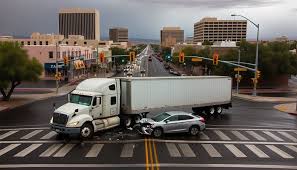
Every day, thousands of passenger vehicles share the highway with massive commercial trucks and 18-wheelers. Most of those trips go without incident. But when a crash does happen between a semi-truck and a standard car, the results are almost always catastrophic. The physics alone paint a grim picture, and the legal and financial consequences for victims can stretch on for years.
According to the Federal Motor Carrier Safety Administration (FMCSA), large trucks were involved in 523,796 police-reported crashes in a single recent year, resulting in 5,936 fatalities and approximately 161,000 injuries. Those numbers do not happen by accident. They are the product of physics, blind spots, long stopping distances, cargo hazards, and systemic gaps in trucking safety protocols.
Understanding why 18-wheeler accidents are so much more dangerous than regular car crashes can help drivers make smarter decisions on the road and better understand their legal rights if they are ever involved in one.
The Massive Size and Weight of Commercial Trucks
The single biggest factor that separates truck accident injuries from car accident injuries is sheer mass. A fully loaded tractor-trailer can legally weigh up to 80,000 pounds under federal regulations. Compare that to the average passenger car, which weighs between 3,000 and 4,000 pounds, and the danger becomes immediately clear.
When two objects collide, the smaller one absorbs a disproportionate share of the impact force. The Insurance Institute for Highway Safety (IIHS) reports that in fatal two-vehicle crashes involving a passenger vehicle and a large truck, 97% of the deaths occur in the passenger vehicle, not the truck.
The result is a pattern of catastrophic injuries in truck accident victims that rarely appear in standard car crash cases: traumatic brain injuries, spinal cord damage, crush injuries, internal organ trauma, and multi-system injuries that can require months or years of medical treatment.
Semi-Truck Blind Spots Are Far Larger Than Most Drivers Realize
One of the most underestimated dangers around commercial trucks is the blind spot problem. Unlike passenger vehicles, which have relatively manageable blind spots, semi-trucks have four large no-zones where the truck driver has little to no visibility.
The Four No-Zones of an 18-Wheeler
- Front blind spot: Directly in front of the cab, extending roughly 20 feet forward
- Rear blind spot: Directly behind the trailer for approximately 30 feet
- Left side blind spot: Running the length of the cab alongside the driver’s door
- Right side blind spot: The most dangerous zone, extending up to two full lanes wide along the right side of the trailer
The FMCSA No-Zone public awareness program exists specifically because passenger vehicle drivers so frequently underestimate these areas. Staying in a truck’s no-zone, even for a few seconds, dramatically increases the likelihood of a serious side-swipe or merge accident that the truck driver may never see coming.
Longer Stopping Distances Create Devastating Rear-End Crash Risk
One of the most common and deadly types of truck accidents is the rear-end collision, and stopping distance is the central reason why.
According to the FMCSA Large Truck Crash Causation Study, a fully loaded 18-wheeler traveling at 65 miles per hour requires approximately 525 feet to come to a complete stop. A passenger car traveling at the same speed typically stops within about 300 feet. That 225-foot difference is more than half the length of a football field.
| Factor | Passenger Car | 18-Wheeler / Semi-Truck |
| Weight | 3,000 – 4,000 lbs | Up to 80,000 lbs |
| Stopping Distance (65 mph) | ~300 feet | 500+ feet (loaded) |
| Blind Spots | Small – rear and sides | 4 large no-zones: front, rear, both sides |
| Fatal Crash Risk to Others | Standard | 97% of fatalities occur in the passenger vehicle |
| Liable Parties | Driver only | Driver, carrier, cargo loaders, manufacturer |
When highway traffic slows suddenly due to an accident, construction, or congestion, that stopping distance gap becomes a life-or-death difference. A driver in a passenger car may stop safely. The fully loaded 18-wheeler behind them may not.
This problem is made worse in bad weather. Wet or icy roads can increase stopping distances by 25% to 50% or more for heavy vehicles, meaning a truck that needs 525 feet to stop on dry pavement could require 650 to 800 feet on a rain-slicked highway.
Cargo Hazards and Equipment Failures Add Another Layer of Danger
Unlike a regular car accident, a commercial truck crash may involve dangers that go far beyond the collision itself. The cargo a truck carries and the condition of its equipment can transform an already serious accident into a multi-vehicle catastrophe.
Common Cargo and Equipment Hazards in Truck Accidents
- Unsecured or improperly loaded cargo: Freight that shifts during a turn or sudden brake can alter the truck’s center of gravity and cause rollovers or jackknife accidents
- Overloaded trailers: Exceeding federal weight limits puts added stress on brakes and tires, increasing the risk of equipment failure
- Tire blowouts: A sudden blowout on a loaded semi at highway speed can cause the driver to lose control instantly
- Brake failures: Commercial truck brakes require regular inspection and maintenance. Brake failure is one of the leading causes of truck accidents nationally
- Hazardous material spills: Trucks carrying flammable, toxic, or corrosive materials can turn a crash into a chemical or fire emergency
The National Highway Traffic Safety Administration (NHTSA) identifies brake problems and tire issues as among the top vehicle-related causes in fatal truck crashes. These are often the result of deferred maintenance, aggressive trucking schedules, and inadequate pre-trip inspections.
Why Are Truck Accident Injuries So Much Worse Than Car Accident Injuries?
This is one of the most common questions people ask after being involved in a crash with a commercial vehicle, and the answer comes down to force, speed, and vehicle geometry.
In a typical car-to-car collision, both vehicles are roughly similar in height, so the impact energy is distributed more evenly. In a truck-to-car collision, the underride phenomenon is a serious risk. This happens when a smaller vehicle slides under the rear or side of a trailer, bypassing the car’s crumple zones entirely and causing the trailer to strike the passenger compartment directly.
The IIHS has documented that underride crashes are among the most fatal types of truck accidents, particularly in rear and side underrides. Federal underride guard standards have improved over the years, but they remain a significant danger on U.S. roads.
Many truck accident survivors sustain traumatic brain injuries, broken vertebrae, amputations, and permanent disabilities that drastically alter the course of their lives.
Trucking Accident Liability Is More Complex Than a Standard Car Crash
One of the most important differences between a commercial truck accident claim and a standard car accident claim is the number of parties that may be legally responsible for what happened. In a typical two-car accident, liability usually starts and ends with the at-fault driver. Truck accident claims are rarely that simple.
- The truck driver, if fatigue, distraction, impairment, or reckless driving contributed to the crash
- The trucking company or motor carrier, which may be liable for negligent hiring, inadequate driver training, or pressuring drivers to exceed hours-of-service regulations
- Cargo loading companies, if improperly secured or overloaded freight caused or contributed to the accident
- Maintenance contractors, if deferred or negligent vehicle maintenance led to a mechanical failure
- Truck or parts manufacturers, if a defective component such as faulty brakes, tires, or a steering system failure contributed to the crash
Truck accident cases also typically involve higher compensation amounts than standard car crash claims. For a detailed overview of how compensation is evaluated, this motor vehicle accident settlement guide covers the key factors that affect what victims may recover.
How Do You Prove Liability After an 18-Wheeler Accident?
Proving fault in a commercial truck accident requires evidence gathering that goes well beyond exchanging insurance information at a crash scene. Because trucking companies often launch their own investigations immediately after a serious crash, the window for preserving critical evidence can be very short.
- Electronic logging device (ELD) data, which records a driver’s hours-of-service and can reveal if the driver was fatigued or in violation of federal rules
- Black box or event data recorder information from the truck, capturing speed, braking, and steering inputs in the moments before impact
- Trucking company maintenance records showing the inspection and repair history of the vehicle
- Driver qualification files, including employment history, drug test records, and training documentation
- Surveillance or dashcam footage from nearby businesses, other vehicles, or the truck itself
- Witness statements and accident reconstruction expert analysis
According to a study cited by the FMCSA, driver-related factors were the most common critical reason assigned in fatal crash causation, appearing in approximately 87% of cases. That data underscores why thorough evidence collection is so essential in these cases.
Why Victims Often Need a Specialized Truck Accident Lawyer
After a serious truck accident, the injured victim is often dealing with hospitalization, surgery, and the shock of a life-altering event. Trucking companies and their insurance carriers, by contrast, are typically experienced at managing accident claims and may dispatch investigators to the scene within hours.
A qualified attorney can send immediate preservation letters to the trucking company demanding that critical data and records not be destroyed. They can retain accident reconstruction experts, medical specialists, and economic loss analysts to build a complete picture of the damages.
For victims in the Houston area, working with an experienced Houston truck accident lawyer who understands Texas trucking law and the tactics used by insurance companies can make a significant difference in the outcome of a claim.
It is also worth noting that Texas follows a modified comparative negligence rule. If a victim is found to be partially at fault, their compensation may be reduced proportionally. Having an attorney who can counter any attempt to shift blame onto the victim is critical to protecting the full value of a claim.
Staying Safe Around Commercial Trucks on the Road
While no driver can fully eliminate the risk of being involved in a truck accident, understanding how 18-wheelers operate gives every driver a meaningful safety advantage.
- Never linger in a truck’s no-zones: If you cannot see the truck driver’s face in their mirrors, they cannot see you
- Leave extra following distance: Increase to at least four to six seconds behind a loaded semi on highways
- Be cautious when passing: Pass trucks quickly on the left side and do not cut back in until the full front of the truck is visible in your rearview mirror
- Watch for wide turns: Never try to squeeze by on the right side of a truck making a right turn
- Stay alert in construction zones and heavy traffic: These are the situations where truck stopping distances become most deadly
The FMCSA’s Share the Road Safely program offers detailed guidance for passenger vehicle drivers on operating safely around commercial trucks and buses.
Understanding the Stakes After a Truck Accident
The gap between an 18-wheeler accident and a typical car crash is not just a matter of degree. It is a difference in kind. The weight of a loaded semi-truck, the size of its blind spots, its stopping distances, the complexity of its cargo, and the number of parties who may share liability all combine to create a type of accident that requires specialized knowledge to navigate, both medically and legally.
If you or someone you love has been seriously injured in a collision with a commercial truck, understanding these dynamics is the first step toward making informed decisions about medical care, insurance claims, and legal options. The consequences of these accidents can be lifelong, and the choices made in the days and weeks after a crash can have a lasting impact on the compensation victims are able to recover.