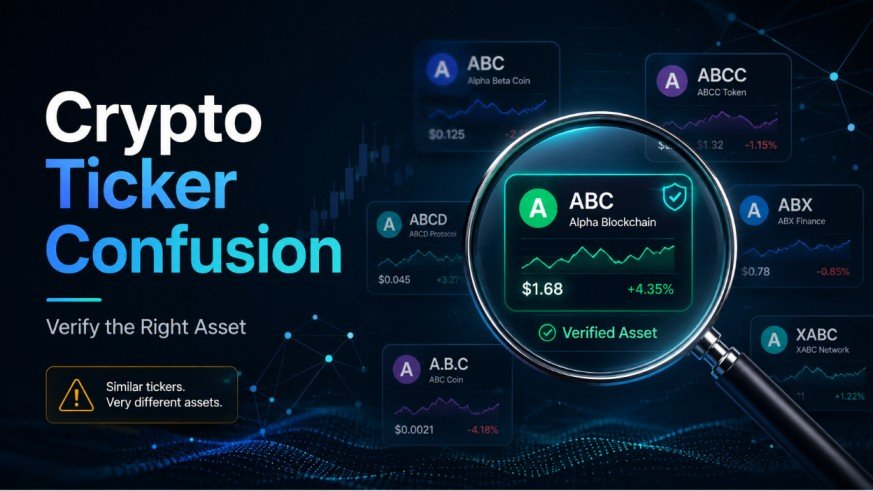
Quick Answer
A crypto ticker alone cannot reliably identify an asset, because unrelated projects can use the same symbol. The safest verification method is to match the full project name, blockchain network, and contract address against the project’s official documentation and a block explorer, then use exchange and market-data listings as secondary confirmation. Contract addresses are unique identifiers on their respective networks, which is why trackers like CoinGecko let users search by both blockchain and contract address rather than by ticker alone.
Never verify a cryptocurrency by ticker alone. Confirm its full name, blockchain network, and contract address first.
Key Takeaways
- Tickers are labels chosen by projects, not universal IDs, duplicates are common, sometimes deliberate.
- The strongest identifier for a blockchain token is its contract address on a specific network.
- A contract-address mismatch usually means a different asset, even if the name and logo match.
- Price similarity and exchange availability are supporting evidence, not proof of identity.
- Verification effort should scale with stakes: research needs less scrutiny than an on-chain transfer.
Typing a ticker into Google, an exchange, a wallet, or a portfolio tracker doesn’t reliably identify one cryptocurrency. Tickers are short labels projects choose for themselves, with no central registry preventing reuse.
Getting this wrong has real consequences: researching the wrong fundamentals, comparing a price or market cap from an unrelated token, buying the wrong asset, importing a fake token, or sending funds over an incompatible network. Below is a repeatable framework for researching, buying, or transferring any unfamiliar token.
Why Can Different Crypto Assets Have the Same Ticker?
A ticker is a label, not a universal crypto ID. Four layers are often collapsed into one:
- Ticker — a short abbreviation, such as XEF.
- Project name — identifies the intended project, though names can still be imitated.
- Network — the blockchain the token actually lives on.
- Contract address — one specific token contract on that network.
Names and logos are copied just as easily as tickers, so matching “name plus ticker” alone isn’t enough.
Collisions happen for several reasons: unrelated projects independently picking the same abbreviation, old or migrated tokens still sitting in databases, bridged versions of an asset on a second network, and deliberately cloned tokens that copy a name and symbol to fool searchers.
How Do You Verify a Crypto Token Before Researching or Buying It?
Work through this checklist in order, each step narrows the field of possible assets.
| Check | What to verify | Why it matters |
| Project name | Matches the project you intended | Eliminates obvious collisions |
| Network | Ethereum, Solana, BNB Chain, XPHERE, etc. | Same ticker can exist on different chains |
| Contract address | Full address, character-for-character | Strongest single identifier |
| Official source | Address confirmed via the project’s own site/docs | Avoids copied or spoofed listings |
| Explorer/tracker | Same address on an explorer and reputable tracker | Confirms metadata and on-chain existence |
| Exchange listing | Name, deposit network, and market pair match | Confirms the exchange means the same asset |
MetaMask advises double-checking URLs and contract addresses before interacting with a token, and notes its “verified” label means an address matches one recognized in its ecosystem, not that the asset is a sound investment.
Price, logo, and ticker are secondary evidence, not proof: prices vary between venues, logos are trivial to copy, and names and tickers can be duplicated outright.
Decision rule: if the contract or network doesn’t match, stop, even if the name and logo look right.
XEF Example: How Ticker Confusion Works in Practice
A reader encountering the “XEF” token on an exchange should first establish exactly which asset the listing refers to, rather than assuming every search result for “XEF” points to the same project.
MEXC’s June 15, 2026 listing announcement identified the asset as XEFFY (XEF), traded as XEF/USDT. CoinGecko lists XEFFY under the XEF symbol, linking its explorer entry to a contract at 0x80252c2d06bbd85699c555fc3633d5b8ee67c9ad on XPHERE 2.0. XEFFY’s documentation describes XEF as its ecosystem token, with a maximum supply of 6 billion XEF.
Now the collision: a separate contract exists under the name XDAO Ecosystem Foundation (XEF) on Ethereum, at a different address entirely. Searching only “XEF price” or “XEF token” can surface data from two unrelated projects mixed together.
The correct conclusion isn’t that one listing is fake, it’s that the ticker alone has failed as an identifier. The reliable path is project name → network → contract address.
What Should You Do When Exchanges, Explorers and Price Trackers Disagree?
Resolve identity before worrying about market data. When sources conflict, weigh evidence in this order: official documentation, the published contract address, the appropriate explorer, an independent aggregator, and only then exchange listings or search results.
Some disagreements are legitimate: price gaps from thin order books, circulating-supply estimates that vary by source, delayed aggregator updates, contract migrations, rebrands, or bridged multichain versions. As of August 11, 2026, CoinGecko tracked XEFFY’s XEF market through a single exchange (MEXC), at roughly $11.2 million market capitalization, a reminder that thin venue coverage makes exchange availability a weak identity signal on its own. Market figures move quickly and should be re-checked before relying on them.
Decision rule: a price mismatch warrants a closer look; a contract-address mismatch usually means you’re comparing two different tokens.
What Red Flags Suggest You May Have Found the Wrong or Fake Token?
Stop and investigate further if you notice any of the following:
- A different contract address under the same ticker than the one you confirmed.
- A correct-looking ticker or logo on a blockchain the project doesn’t normally use.
- A contract address sourced only from Telegram, Discord, ads, or comment replies.
- A website or domain that differs subtly from the project’s official links.
- Explorer activity inconsistent with the project’s known launch date or history.
- Suspiciously thin liquidity, or a token that can be bought but shows no sell activity.
- A wallet or security service flagging the contract as malicious or unverified.
MetaMask notes an absence of sell transactions can be one indicator of honeypot-style malicious contracts, though no single signal proves fraud alone.
Verification and due diligence are different questions. Verification answers “is this the asset I intended?” Due diligence answers “is this asset worth the risk?” A correctly verified contract can still carry poor liquidity, weak tokenomics, centralized control, or extreme volatility.
How Much Verification Is Needed Before Researching, Buying or Transferring Crypto?
The right level of scrutiny depends on what you’re doing with the asset:
- Researching — name + ticker + network + contract address, to avoid mixing market caps or news from unrelated projects.
- Buying or trading — add exchange pair + liquidity + deposit/withdrawal network. A listing is not an endorsement of quality.
- Withdrawing or sending on-chain — the highest-stakes case: token contract + sending network + receiving network/address compatibility, since incorrect on-chain transfers can be difficult or impossible to reverse. Uniswap warns that assets sent to the wrong address or network may not be recoverable.
Practical rule: for any transfer that matters, verify the entire address rather than just the first and last few characters.
Read more: How to Build Long-Term Wealth Through Investing
Conclusion: Verify the Asset Before You Analyze the Asset
The core rule: ticker → full name → network → contract address → official or explorer confirmation → market data. Solving crypto ticker confusion takes seconds, but it prevents research errors and transaction mistakes that can be far more costly to undo.
If two sources show the same ticker but different networks or contract addresses, treat them as different assets until you’ve proven otherwise.
Crypto Ticker Confusion FAQ
Can two cryptocurrencies have the same ticker?
Yes. No central authority prevents reuse, so treat a ticker as a search label, not proof of identity.
Is the contract address enough to identify a token?
Combine it with the network, the same address format can exist across multiple EVM-compatible chains.
What if a cryptocurrency has no contract address?
Native coins aren’t identified by a token contract. Verify the official network and project documentation, and check which wallets or exchanges support it.
Why can the same token show different prices across exchanges?
Liquidity, spreads, order-book depth, and update timing cause price gaps between venues. Tax and regulatory treatment of crypto also varies by jurisdiction, so confirm local rules separately.