

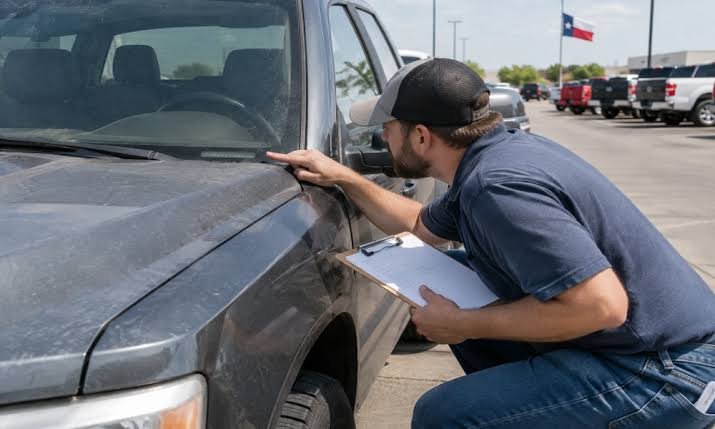
The sun was low enough that afternoon to skim right across the hood. That’s when I saw them. Dozens of shallow dimples, evenly spread, the kind you’d never notice at noon under a dealership canopy. The salesman said the truck had a clean history. He wasn’t lying, exactly. Nobody had ever filed a claim. It was a good reminder that used trucks in dallas carry a weather history of their own, and most of it never makes it onto paper.
Reading a Hood Under Low Light
Hail damage hides well. Overhead lighting flattens everything, and a fresh wash makes paint look better than it is. Go early in the morning or late in the day, and crouch so you’re looking along the panels rather than straight at them. Small dents show up fast that way. The roof matters most, since nobody sees it.
- Check the roof, hood, and top of the bed rails first.
- Look at the reflection of a straight line, like a light pole, across each panel.
- Run a flat palm slowly over the roof to feel for dimples.
- Inspect plastic mirror caps and trim for small cracks.
When Hail Shows Up on Paper
Some storms leave a paper trail. When an insurer decides repairs cost too much, the truck may get a salvage or rebuilt title. That changes resale value and sometimes what insurance companies will offer you. Hail-damaged used trucks in dallas aren’t automatically a bad buy, as long as the price reflects the damage and the title is honest about it. The trouble starts when the dents were repaired quietly, and the history report shows nothing. Ask directly. Then check the report anyway.
What a Texas Summer Does Underneath
Heat is slower than hail. It doesn’t leave marks you can feel with your hand. Long stretches of triple-digit days wear down batteries, belts, and rubber hoses faster than they’d age in a milder place. Batteries in North Texas often last about three years, sometimes less. The air conditioning deserves a proper test too, not a quick blast while the truck idles in the shade.
- Find the battery’s date code and note how old it is.
- Squeeze radiator hoses gently, looking for cracks or soft spots.
- Run the AC for ten minutes and check that it stays cold.
- Look at the dashboard for cracks from years of sun.
Highway Miles Wear Differently
A lot of trucks here spend their lives on long freeway commutes. That’s mostly good news. Steady highway driving is gentler on brakes and transmissions than short trips across town. It does leave its own marks, though. Windshields collect small pits from road debris. Front bumpers and the leading edge of the hood pick up rock chips, and tires can wear unevenly if alignment was ignored. None of it is a dealbreaker. It just belongs in the price conversation.
Common Weather and Road Wear Costs
|
What You Find |
Where to Look |
Rough Repair Cost |
|
Light hail dents |
Roof, hood, bed rails |
$500 to $2,500 with paintless repair |
|
Heavy hail damage |
Replaced or repainted panels |
$3,000 to $10,000 or more |
|
Aging battery |
Date code older than three years |
$150 to $300 |
|
Weak air conditioning |
Cooling that fades after a few minutes |
$200 to $2,000 |
|
Pitted windshield |
Glare spots in direct sunlight |
$300 to $1,000, more with camera calibration |
The point of the table isn’t to scare anyone off. It’s to show which problems are small enough to negotiate around and which ones can quietly double the cost of a truck that looked like a bargain.
Things People Ask Me About Dallas Trucks
These questions come up whenever someone starts looking at trucks in this area. The answers are fairly simple once you know where to look.
- Will a history report show hail damage? Only if an insurance claim was filed or the title was branded. Plenty of trucks get dented and never show up on any report.
- Is paintless dent repair a red flag? Not really. It’s a common, clean fix for light hail. Just ask for the receipt.
- How do I know if a battery is struggling? Look for slow cranking on a cold start, or a date code more than three years old. Many parts stores will test it for free.
- Are highway miles really better than city miles? Generally, yes. A truck with 60,000 freeway miles often has less wear than one with 40,000 miles of stop-and-go driving.
- Should I avoid a truck with a rebuilt title? Not always, but expect lower resale value and check with your insurer before buying.
I did end up asking about that dimpled truck. The seller’s son pulled out his phone and showed me a video from two springs earlier, ice bouncing off the driveway while the truck sat out in the open because the garage was full of boxes. The dents were still there, every one of them. So was the price, about $3,000 lower than it had been the week before.


